
Calculating the Hidden Costs of Failed Experiments in Peptide Research (2026)
By Peak Haven12 min read
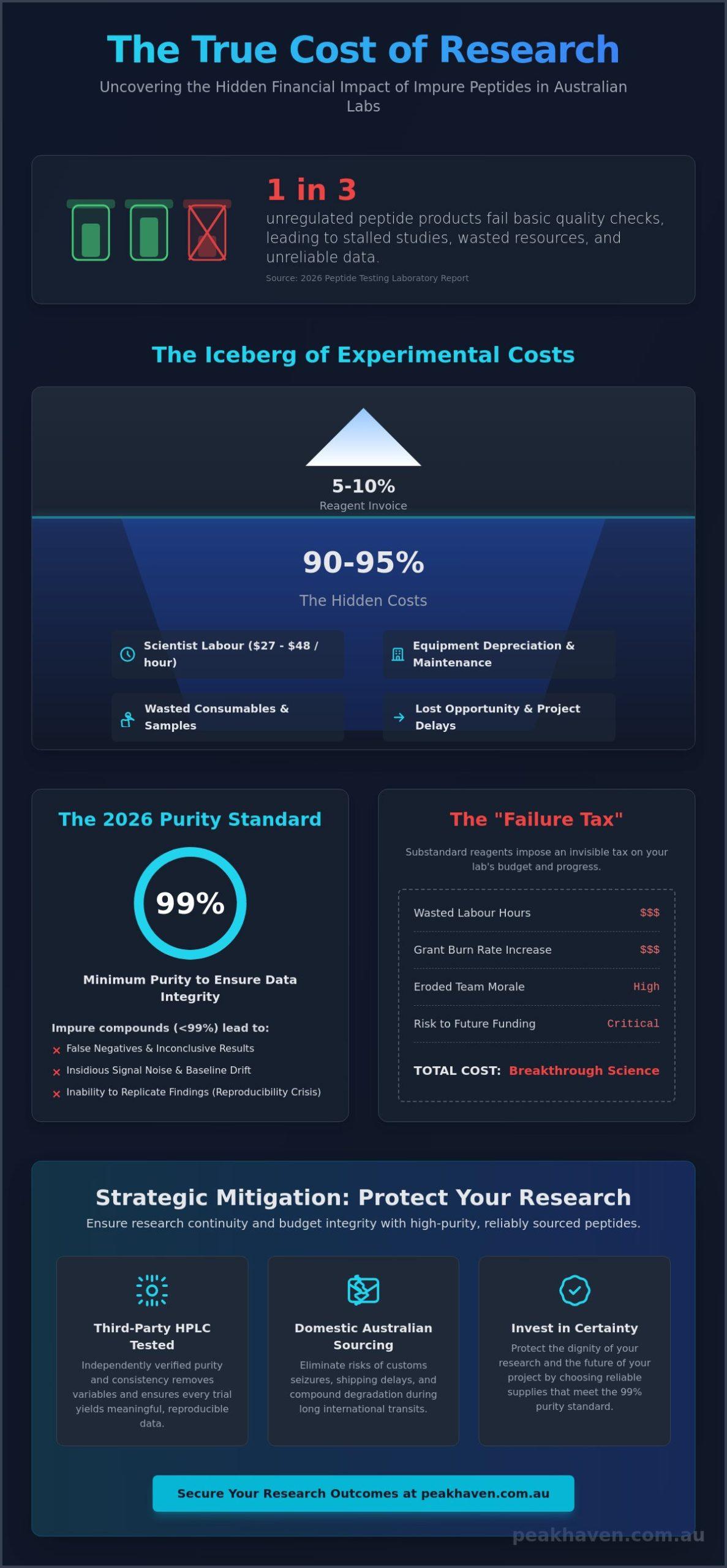
Did you know that a 2026 report from a peptide testing laboratory revealed that approximately one third of analyzed unregulated peptide products failed basic quality checks? When your lab is faced with inconsistent data, you aren’t just losing a reagent; you’re losing valuable time and resources. For many Australian researchers, calculating the hidden costs of failed experiments means looking beyond the invoice to account for scientist labour rates that currently average between $27 and $48 per hour. We understand how frustrating it is to see a promising study stalled by unreliable compounds that don’t meet the new 2026 industry standard of 99% purity.
You deserve a partnership that prioritises your project’s integrity as much as you do. In this guide, we’ll show you how to quantify the true financial impact of laboratory failures and build a clear framework for the ROI of high-purity supplies. We’ll examine how sourcing HPLC tested peptides Australia can eliminate the risk of false negatives in your cellular studies. By the end, you’ll see why streamlined procurement through Peak Haven protects your budget and your scientific outcomes with reliable, Australian-based shipping.
Key Takeaways
- Master a precise framework for calculating the hidden costs of failed experiments by accounting for researcher labour and equipment depreciation alongside reagent price.
- Understand why the 2026 industry standard of 99% purity is essential for avoiding false negatives and signal noise in sensitive metabolic studies.
- Learn how to identify the “Failure Tax” that substandard reagents impose on your laboratory’s long-term budget and scientific progress.
- Discover the logistical advantages of domestic Australian sourcing to eliminate the risks of customs seizures and compound degradation during transit.
- Optimise your procurement process with third-party HPLC tested peptides to ensure every trial contributes to meaningful, reproducible data.
The Anatomy of a Failed Experiment: Beyond the Initial Reagent Budget
In the 2026 biotech landscape, a “failed experiment” is rarely a simple “it didn’t work” result. Instead, it manifests as insidious signal noise, baseline drift, or devastating false negatives that can lead a team down a six month path of incorrect conclusions. When calculating the hidden costs of failed experiments, we must look at the “Tip of the Iceberg” effect. While the invoice for a compound like Semaglutide 10mg might seem like the primary expense, it typically represents only 5% to 10% of the total trial cost. The rest of your budget is buried in non-recoverable biological samples and lost laboratory time.
This discrepancy is a major contributor to the global reproducibility crisis, where researchers struggle to validate findings due to inconsistent variables. While productive failure is a natural part of the scientific journey, avoidable failure caused by impure reagents creates an unnecessary psychological toll on research teams. It erodes the sense of agency and empowerment that scientists need to pursue breakthrough discoveries. We believe your research should be defined by your goals, not by the frustration of compromised data integrity.
To better understand the mathematical impact of these discrepancies and how they affect your data, watch this helpful video:
The ‘Fail Fast’ Fallacy in Biotechnology
The popular software mantra of “failing fast” doesn’t translate well to longitudinal peptide studies. In code, a bug is fixed with a keystroke; in the lab, a contaminated trial requires a complete re-clearing of the workspace and disposal of expensive consumables. Avoidable failure is the primary drain on Australian research grants. It consumes resources that could have funded secondary phases of a study or allowed for a larger sample size. When you choose reliable supplies, you’re choosing to protect the dignity of your research and the future of your project.
Identifying Avoidable Variables in Peptide Synthesis
Batch-to-batch inconsistency is the silent killer of research integrity. When a peptide contains residual solvents or high levels of Trifluoroacetic acid (TFA), it creates “ghost” results that are impossible to replicate. This is why we advocate for using HPLC tested peptides Australia for every study. By removing these variables, you ensure that your cellular responses are triggered by the peptide itself, not by contaminants left over from a cut-price synthesis process. Our BPC-157 and TB-500 blend, for example, undergoes rigorous third-party testing to ensure your results remain consistent across every trial phase.
Quantifying the Invisible Drain: Labour, Time, and Opportunity Costs
When we move beyond the immediate loss of reagents, the true scale of laboratory failure becomes visible. For Australian labs, calculating the hidden costs of failed experiments requires a rigorous look at the invisible drain on human and mechanical capital. Every hour spent troubleshooting a bad batch is an hour stolen from breakthrough science. This inefficiency contributes to a global crisis of irreproducible research, which has been estimated to result in annual costs of approximately $28B in the United States alone. In Australia, the economic impact is similarly profound, as limited grant funding must stretch further to cover rising operational overheads.
Beyond the payroll, we must consider equipment depreciation. High-end machinery like HPLC and mass spectrometers have finite lifespans and high maintenance costs. Running failed samples through these machines isn’t just a waste of time; it’s a “rental” cost that yields zero return on investment. This shortens the runway for critical clinical milestones, effectively increasing your grant burn rate and putting future funding at risk. When you lose a month to signal noise, you aren’t just losing money; you’re losing your competitive edge in the global research community.
The Researcher Hour: Your Most Expensive Reagent
A PhD researcher?s time is your lab’s most precious resource. With scientist labour rates sitting between $27 and $48 per hour in 2026, a single week of failed assays can cost thousands in wages alone. This doesn’t even account for the administrative burden of documenting failures for ethics committees or stakeholders. Sourcing Retatrutide 20mg with verified pharmaceutical grade purity ensures that your team’s expertise is spent on analysis, not on solving procurement-induced puzzles. It’s about giving your staff the tools they need to succeed, rather than forcing them to manage the fallout of inconsistent supplies.
The Compound Interest of Data Corruption
Data corruption has a compounding effect. One bad result can invalidate months of prior successful data if the purity of the baseline compound is called into question. This leads to the ultimate “failure tax”: the cost of retraction risk for academic and commercial institutions. We aim to help you maintain a “haven” of data integrity through strict procurement standards. By choosing high-purity research peptides Australia, you protect your lab’s reputation and ensure your journey toward discovery remains on a steady, predictable path. It’s a collaborative step toward more reliable science and a more fulfilling research career.
The Purity Variable: How Substandard Peptides Corrupt Data Integrity
While some vendors still offer 95% purity as a baseline, this margin of error is often insufficient for modern metabolic research. In sensitive studies involving Semaglutide 10mg, even a 5% impurity profile can introduce bioactive contaminants that skew insulin sensitivity markers or inflammatory responses. This data corruption is a core pillar of the financial drain discussed in The Economics of Reproducibility in Preclinical Research. When you look at the raw numbers, the “Purity Premium” of a high-grade compound is negligible compared to the “Failure Tax” of a month-long trial that yields unpublishable results.
Calculating the hidden costs of failed experiments means acknowledging that impurities aren’t just “blank space” in a vial. They are often truncated peptide sequences or residual reagents that compete for receptor binding sites. This interference creates signal noise that masks the true efficacy of your research. By investing in pharmaceutical grade peptides, you’re essentially taking out an insurance policy on your laboratory’s most valuable asset: its data integrity. We believe that every researcher deserves the peace of mind that comes from knowing their reagents won’t be the variable that compromises their goals.
HPLC Testing: The Gold Standard for Cost Mitigation
A Manufacturer?s Certificate of Analysis (COA) is often a static document that doesn’t reflect the specific batch on your bench. Independent, third-party HPLC verification provides a real-time snapshot of chemical integrity, allowing you to spot baseline drift or hidden peaks before they enter your in-vitro models. Peak Haven verifies every batch to ensure >99% purity, providing the transparency you need to maintain control over your scientific journey.
Reconstitution and Storage: Preventing Post-Purchase Failure
Even the highest purity compound can fail if the reconstitution protocol is flawed. Using low-quality diluents can introduce pH imbalances or microbial growth that degrades the peptide bond almost immediately. This is why using pharmaceutical-grade bacteriostatic water is a non-negotiable, low-cost way to prevent high-cost failure. Proper handling also prevents thermal shock, which is particularly vital for delicate sequences like our BPC-157 + TB-500 blend. To secure the integrity of your next study, explore our range of HPLC tested peptides Australia today.
Strategic Mitigation: Ensuring Research Continuity with Peak Haven
Mitigating laboratory risk requires a fundamental shift in procurement strategy. When calculating the hidden costs of failed experiments, many Australian labs discover that international sourcing is their most significant point of failure. Border seizures, unexpected customs delays, and the lack of local accountability don’t just strain your budget; they cause compound degradation that can invalidate your research before the vial is even opened. By choosing a domestic partner, you regain choice and control over your supply chain, ensuring your journey toward discovery remains uninterrupted and scientifically sound.
We see ourselves as more than just a supplier; we are a steady hand in a complex regulatory system. Our commitment to transparency and purity is designed to alleviate the stress often associated with high-stakes biotechnology research. We believe that by providing a reliable “haven” for your reagent needs, we empower you to focus on what truly matters: the aspirations of your research and the potential for life-changing breakthroughs. Auditing your current supply chain for these hidden failure points is the first collaborative step toward a more efficient and fulfilling laboratory environment.
The Australian Advantage: Speed and Security
Shipping sensitive compounds from Melbourne and Sydney significantly reduces the risk of “heat-death” during transit, a common issue with international orders that spend days on hot tarmacs. Beyond the physical security of your reagents, domestic sourcing provides a clear financial benefit by shielding your grant from international currency fluctuations and expensive import duties. For research professionals in Australia, having a local ally means you can implement Just-In-Time (JIT) procurement. This reduces your storage overhead and ensures that every peptide used in your protocol is as fresh and stable as possible.
Building a Fail-Safe Research Protocol
Reliability starts with standardisation. By committing to HPLC-tested compounds like GHK-Cu 100mg, you remove the most dangerous variable from your assays. We recommend implementing a “double-check” system for every reconstitution and storage step to ensure that your high-purity reagents maintain their integrity throughout the study. This disciplined approach, combined with our third-party verified supplies, creates a fail-safe environment where results are reproducible and budgets are protected. It’s time to stop calculating the hidden costs of failed experiments and start investing in guaranteed outcomes. Secure your lab’s future with Peak Haven’s HPLC-verified research compounds today.
Securing the Future of Your Laboratory Research
Protecting your lab’s integrity starts with a shift in perspective. We’ve explored how calculating the hidden costs of failed experiments involves more than just the price of a vial. It’s about accounting for the $27 to $48 hourly labour rates of your skilled researchers and the finite lifespan of your specialised equipment. When you prioritise 99% purity standards, you aren’t just buying a reagent; you’re securing the reliability of your data and the longevity of your grant funding.
Peak Haven is here to be your steady partner in this scientific journey. We provide third-party HPLC purity verification on all batches and strictly pharmaceutical-grade research compounds to ensure your results remain consistent. With Australia-wide express shipping from our hubs in Melbourne and Sydney, you can avoid the thermal degradation and customs delays that often compromise international orders. We invite you to protect your research budget with HPLC-tested peptides from Peak Haven. Your goals are within reach; we’re honoured to help you achieve them with confidence and clarity.
Frequently Asked Questions
What is the most common cause of failed peptide experiments?
Substandard reagent purity and batch-to-batch inconsistency represent the most frequent causes of failure in peptide trials. A 2026 analysis by a testing laboratory found that 33% of unregulated peptide products failed basic quality checks. These impurities introduce variables that your research protocol can’t account for, leading to signal noise and unrepeatable data. Choosing verified compounds ensures you maintain control over your scientific journey.
How do I calculate the ROI of buying higher-purity research peptides?
You can determine this by comparing the marginal price increase of premium reagents against the total trial cost, which includes researcher hours and equipment depreciation. When calculating the hidden costs of failed experiments, you’ll find that the “Purity Premium” is usually less than 10% of the total budget. This small investment acts as an insurance policy against the “Failure Tax” of a month-long dead-end study.
Can impure peptides produce false-positive results in metabolic studies?
Yes, impure peptides frequently trigger false-positive or false-negative results by introducing bioactive contaminants into your models. These contaminants, such as truncated sequences or residual solvents, can bind to receptors and mask the true metabolic response of the primary compound. This data corruption is a major driver of the reproducibility crisis currently affecting billions of dollars in annual research funding globally.
How much does laboratory downtime cost the average Australian research project?
Downtime costs for Australian projects are primarily dictated by the $27 to $48 hourly labour rate for PhD researchers and fixed laboratory overheads. If a project is stalled for even a week due to a customs failure or a bad batch, the non-recoverable financial loss can reach thousands of dollars. Using domestic, Australian-based shipping helps you avoid these costly interruptions and keeps your research on a steady path.
Why is HPLC testing more reliable than a standard manufacturer’s certificate of analysis?
A manufacturer’s Certificate of Analysis (COA) is often a generic document that doesn’t always reflect the specific vial on your laboratory bench. Independent, third-party HPLC testing provides a batch-specific snapshot of chemical integrity and sequence purity. This verification is essential for identifying hidden impurities that a standard COA might overlook, ensuring every trial is based on a pharmaceutical-grade foundation for your study.
Does the choice of bacteriostatic water impact the success rate of my experiment?
The choice of diluent is a critical, yet often overlooked, factor in experiment success. Using low-quality water can introduce pH imbalances or microbial contaminants that degrade delicate peptide bonds almost immediately upon reconstitution. We provide pharmaceutical-grade bacteriostatic water to ensure your compounds remain stable and protected throughout your longitudinal studies, significantly reducing the risk of post-purchase failure and protecting your research budget.

Disclaimer
The products discussed in this article are intended strictly for laboratory and research purposes only. They are not intended for human consumption, therapeutic use, or as dietary supplements. Nothing in this article should be interpreted as medical advice, a diagnosis, or a recommendation for treatment. Always consult a qualified healthcare professional for any medical concerns.
Peak Haven supplies research-grade peptides exclusively for scientific and clinical research use. All products undergo independent third-party HPLC testing to verify purity and composition. By purchasing from Peak Haven, you confirm that products will be used solely for legitimate research purposes in accordance with all applicable Australian laws and regulations.
The information presented in this article is based on published scientific literature and is provided for educational purposes only. Peak Haven makes no claims regarding the efficacy or safety of any compound for human use. Individual research results may vary. References to studies or research findings do not constitute endorsement of any specific application.